01 / Independent aerospace project
Parametric
Rocket
A 650 mm rocket design carried through CAD, flight simulation, and Python analysis. Each phase uses the previous phase’s data to make the next engineering decision.
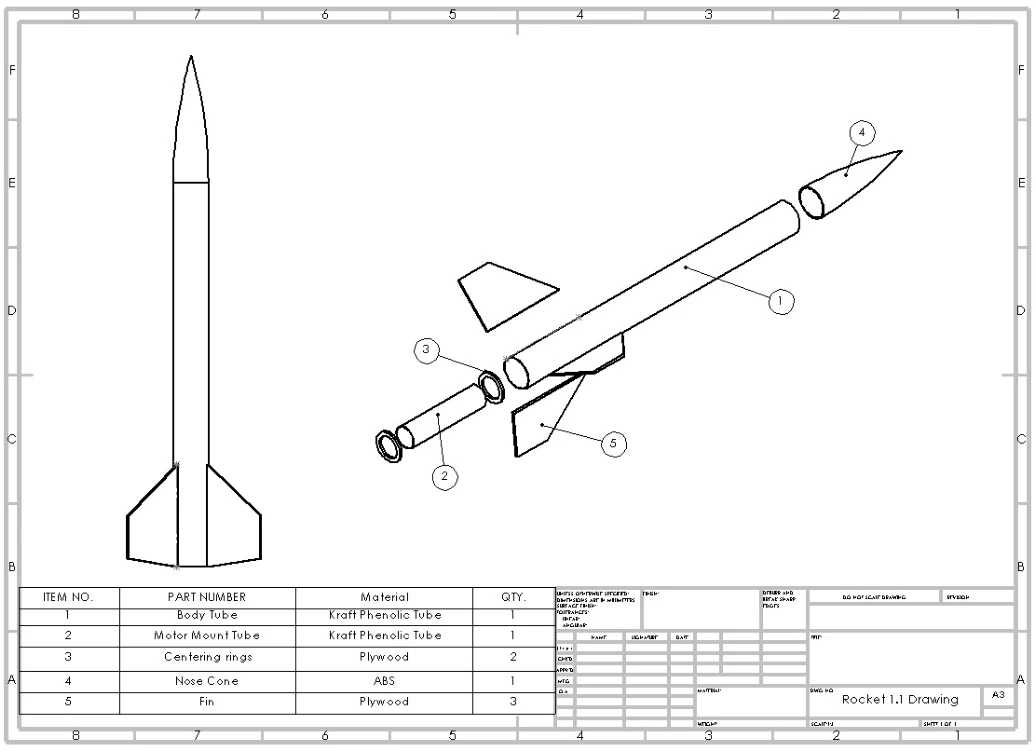
SolidWorks assembly drawing from my Phase 1 report. This project documents a digital design and simulations; it does not claim a physical launch.
Phase 01
Build the model.
I designed five separate SolidWorks parts: a body tube, tangent ogive nose cone, motor mount tube, centering ring, and fin. I assigned real materials, assembled the parts with mates, and extracted mass properties.
The 150 mm nose cone uses an equation-driven tangent ogive profile. Three 3 mm plywood fins complete the assembly. I corrected inconsistent ring and motor-mount dimensions before assembly, then documented the design with an exploded drawing and bill of materials.
Phase 02
Compare the flights.
I rebuilt the geometry in OpenRocket and replaced its mass and center-of-gravity estimates with my SolidWorks values. I compared the AeroTech F42-8, G80-7, and G125-9 against a 300–500 m apogee target.
| Motor | Apogee | Max velocity | Max acceleration | Time to apogee |
|---|---|---|---|---|
| F42-8 · selected | 507 m | 185 m/s | 316 m/s² | 8.07 s |
| G80-7 | 809 m | 302 m/s | 380 m/s² | 9.12 s |
| G125-9 | 867 m | 342 m/s | 510 m/s² | 9.66 s |
The F42-8 came closest to the target and produced the gentlest simulated flight. Its stability margin was 1.16 calibers at Mach 0.3—stable, but below my 1.5–2.0 target. Its 8 s ejection delay also exceeded the 6.6 s optimum reported by the simulator.
For a future iteration, my report proposes adding nose weight to shift the CG forward. That adjustment has not been presented here as a completed improvement.
Phase 03
Read the data.
I wrote a Python function to clean OpenRocket CSV exports, skipping comments and blank lines before building numeric pandas DataFrames. I loaded all three flights, summarized the maxima, and plotted altitude, velocity, and acceleration against time.
The analysis gives apogees of 507.2 m, 809.1 m, and 866.6 m. I checked the summary against OpenRocket’s results. The G125-9 time-to-apogee value differs slightly: 9.63 s in the Python export analysis versus 9.66 s in the simulator table.
The plots also reveal the F42 parachute event as a small bump in velocity and acceleration. That gave me more insight than the summary table alone.
Source material
Read the reports.
Let’s connect